Home / Balustrades & balconies / Steel balustrade
Balustrades & balconies
Steel balustrade, made in Westerham and fitted across Kent, Surrey and South London
Mild steel gives the most strength for the money, meets the regulations without fuss and, once galvanised, lasts decades outside. Stainless steel is the choice when the metal itself is the finish. Here is how we build both for stairs, landings, balconies and external handrails, how they are fixed, and what moves the price.
Mild steel balustrades
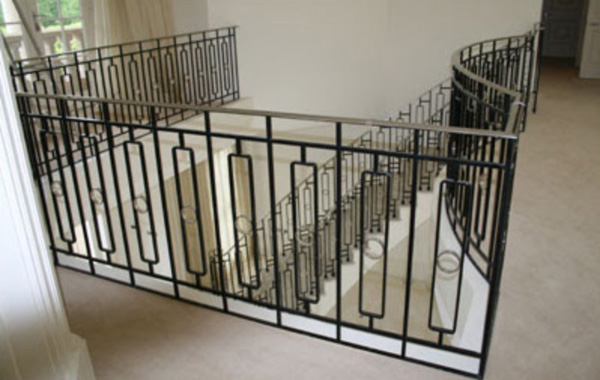
Most metal balustrading starts as mild steel. A typical run is 12mm solid square or round bar verticals welded to a 40mm by 10mm flat bar bottom rail, posts in 40mm or 50mm square hollow section at 1m to 1.2m centres, and a handrail in 40mm by 10mm flat, 42.4mm round tube or a shaped section that sits well in the hand. Everything is welded in the workshop, ground back and checked against the drawing before it leaves, so on site it is a matter of drilling and bolting. Mild steel bends and rolls, so curved landings, sweeping handrails and period detail are all straightforward. It has to be protected from rust, which the finishes section covers, but hot-dip galvanised it needs no attention for years.
Stainless steel balustrades
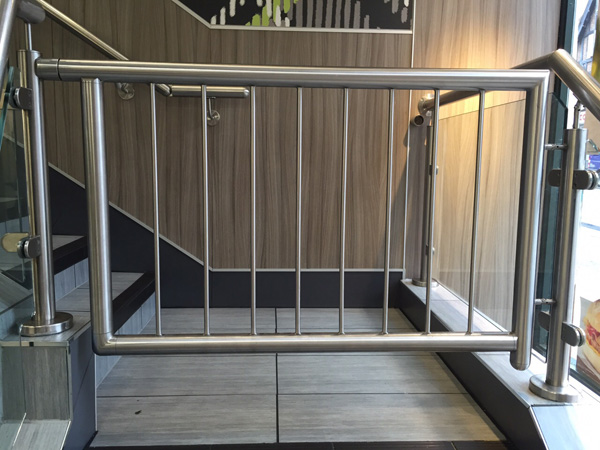
Stainless steel balustrades are built from tube rather than solid bar: 42.4mm or 48.3mm posts and handrail, with 12mm or 16mm tube infill bars, glass clamps or wire between them. We use grade 304 inside and in sheltered spots, and grade 316 outside, where salt and road grit in the air would leave brown tea staining on 304. The standard finish is brushed satin, which hides fingerprints and light scratches; mirror polish is possible but shows everything. Joints are welded and dressed, or made with fittings where the design or the budget calls for it. Stainless costs more than galvanised mild steel and still wants washing down outside, but nothing ever needs painting and a stainless steel handrail is comfortable to hold in any weather.
Heights, gaps and loads under the regulations
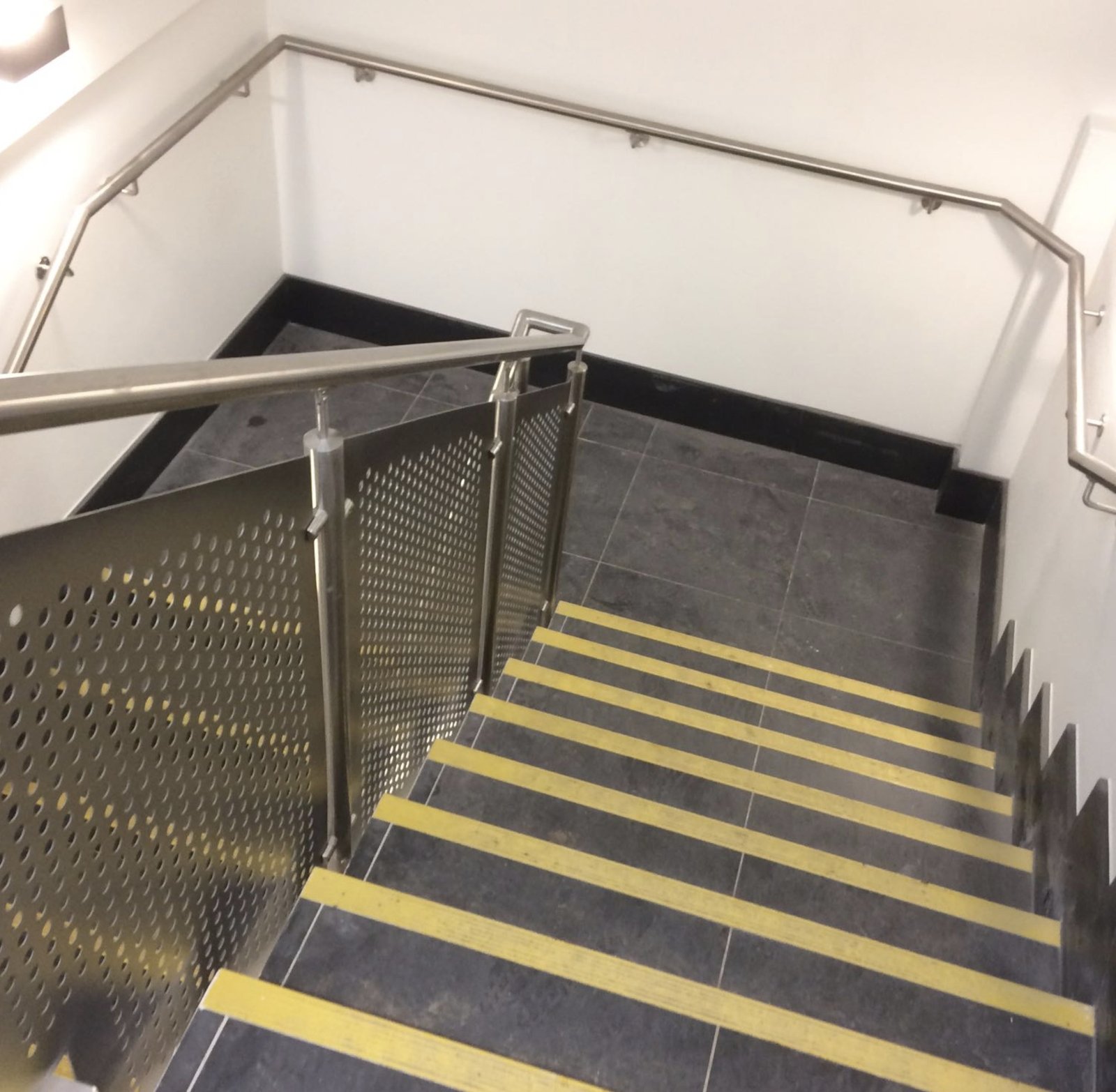
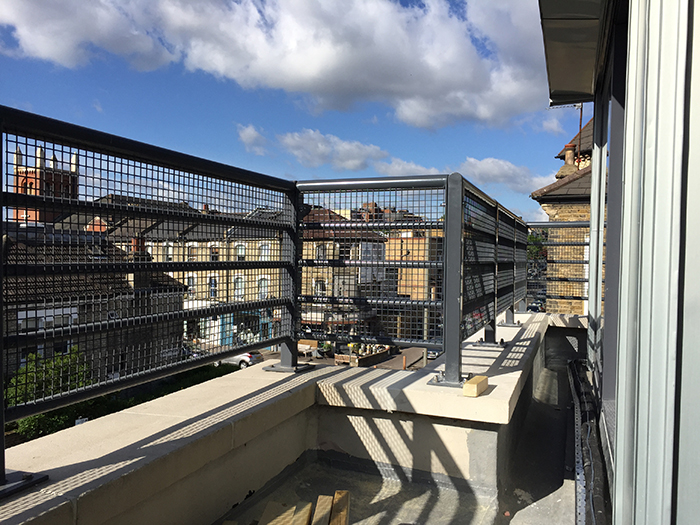
Under Approved Document K, guarding in a house is 900mm high on stairs, landings and internal floor edges, 1100mm on balconies and roof terraces, and no gap may let a 100mm sphere through. Vertical bar at 99mm clear spacing meets both and cannot be climbed, so it is our default. Horizontal rails are climbable and not accepted where children under five are likely; mesh, perforated or glass infill in a flat bar frame gets round that. The handrail sits 900mm to 1000mm above the pitch line and carries on across landings. BS 6180 sets the line load: 0.36 kN per metre inside a single house, 0.74 on its balconies and roof edges, up to 3 kN per metre where crowds gather. Post size, spacing and fixings follow from that figure, and we supply drawings and calculations where building control asks.
Fixings and what the survey checks
A balustrade is only as good as what it is bolted to. Posts stand on base plates bolted down, fix to the side of a slab or stringer on a plate, or are core drilled into concrete and grouted. Into concrete we use resin anchors or through-bolts; into brick, longer resin anchors with spreader plates; into steel stringers, bolts through the web; into timber joists, bolts through the joist with a plate on the back, never screws into the deck alone. The free site survey checks the edge detail, what is behind the surface, the level and line of the run, where the posts can land without hitting a joint or a joist, and how the handrail ends at walls and newels. Curved work is measured and templated on site.
Finishes for inside and outside
Any external steel balustrade should be hot-dip galvanised. After fabrication the steel goes to the plant with vent and drain holes drilled in every hollow section, so the zinc reaches inside the posts as well as over the welds, and water can never sit in them and freeze. Left plain it is a mottled grey that dulls to matt. Most people then have it powder coated, usually black or anthracite grey (RAL 9005 or RAL 7016), which gives a smooth colour coat over the zinc. Internal balustrades are powder coated straight from the workshop, or primed and painted on site if you want to match the joinery. Every hole and bracket is drilled before coating so nothing is cut on site and left bare. Stainless needs no coating, just the satin finish and a wash down.
External handrails and balcony balustrades
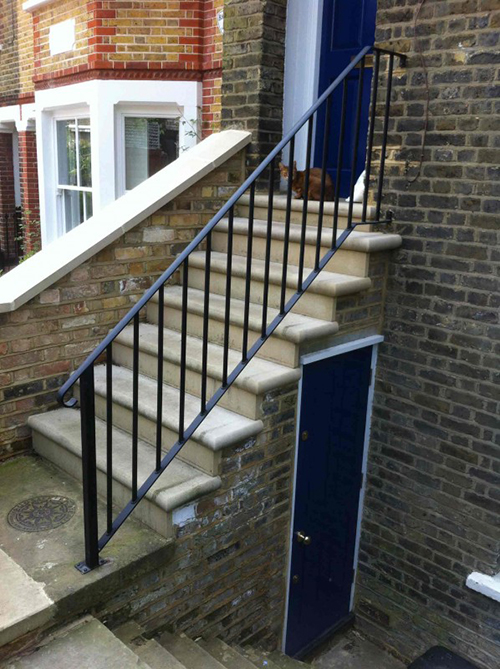
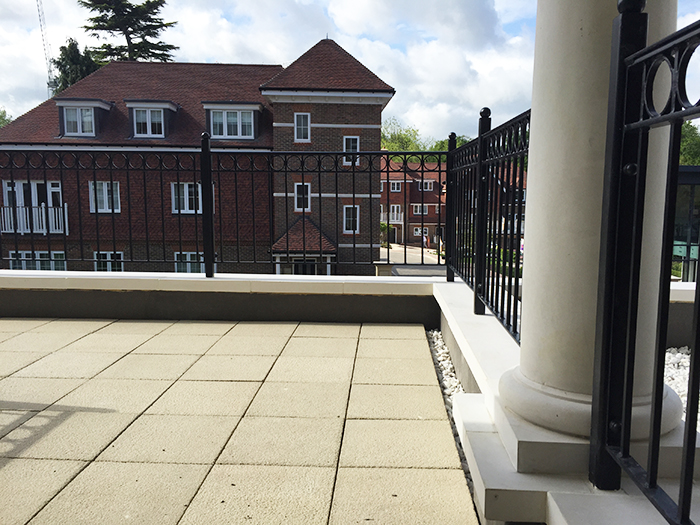
Two jobs deserve their own notes. External handrails on front steps, side paths and ramps are usually a single 42.4mm tube or flat bar rail on posts, galvanised and powder coated, set 900mm to 1000mm above the step nosings with returned ends so sleeves and bags do not catch. Balcony balustrades go to 1100mm, carry a higher load, take the wind and the weather, and fix into a slab edge or steel frame that lives out in the rain. For those we use galvanised mild steel or 316 stainless, resin anchors into concrete, and a base detail that keeps the post foot clear of standing water. Both are drawn, made and fitted by the same team that measured them, so nothing is lost between the site and the workshop.
Price and lead time
Steel balustrade is priced by the metre run, adjusted for design and fixings. Plain vertical bar in galvanised mild steel is the cheapest per metre. Powder coating adds a second process, stainless adds material cost, curved sections add rolling and templating, and awkward fixings into old brick or over a drop add time on site. Send photos or drawings with a rough length and we send a written estimate within the working day. After the free survey you get a fixed quotation that only changes if the design changes. Fabrication and galvanising together take weeks rather than days; internal powder coated work is quicker because it misses the galvanising plant. Fitting a straight run is usually a day. We cover Kent, Surrey and South London from Westerham, and the phones are answered from 6am to 10pm, seven days a week.
Straight answers on steel balustrade
What height does a steel balustrade need to be?
In a house, 900mm on stairs, landings and internal floor edges, and 1100mm on external balconies, roof terraces and flat roof edges, measured from the finished floor or the pitch line of the stair. In flats, offices and public buildings the landings and floor edges go to 1100mm as well, and the loads are higher. Wherever it is, no gap may let a 100mm sphere through.
Should I choose mild steel or stainless steel?
Galvanised and powder coated mild steel for most jobs: it is cheaper, takes any colour, and bends and rolls for curves and period detail. Stainless where you want the metal to be the finish, where nothing can be painted, or near the coast and on busy roads, and then it should be grade 316 outside and 304 inside.
Can you match an existing railing or period style?
Yes. Mild steel bends, rolls and takes forged and cast detail, so we can copy an existing pattern, tie in with a neighbour's railing or draw something in keeping with the house. We measure and template on site and you see the drawing before anything is cut.
Will a galvanised balustrade rust?
Not for a very long time. Hot-dip galvanising coats every surface with zinc, inside the hollow sections and out, and the zinc corrodes in place of the steel. Powder coating over the galvanising protects the zinc and gives the colour. Bare cut edges are the only weak point, which is why every hole is drilled before the steel goes to the plant. A chip in the coating is touched in with zinc-rich paint and goes no further.
Can you fit a steel balustrade to a timber deck or landing?
Yes, as long as we can bolt through the joists rather than into the deck boards. Posts fix with through-bolts and a plate on the back of the joist, or to a steel sub-frame where the timber is not up to it. The survey checks this before we quote, so the fixed quotation already allows for it.
Recent work
Steel balustrade we have made and fitted
Also in Balustrades & balconies
Related work
Balustrading
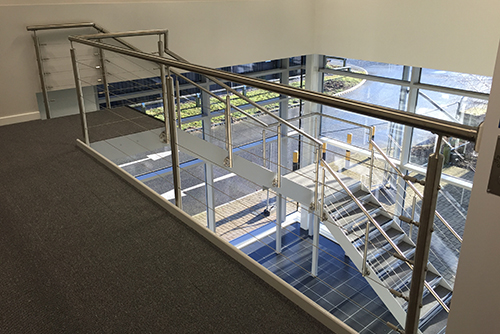
Steel bar, glass, stainless, wire and panel balustrading for stairs, landings, balconies and terraces.
See the page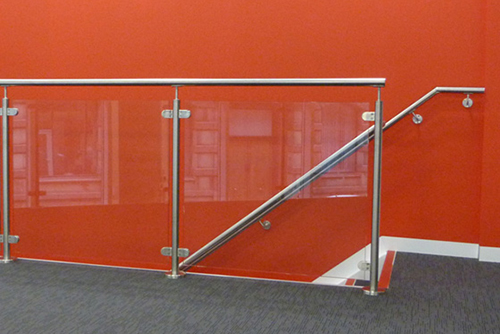
Glass balustrade
Frameless, semi-framed and post-fixed glass balustrades with stainless steel handrails, surveyed, made and fitted.
See the page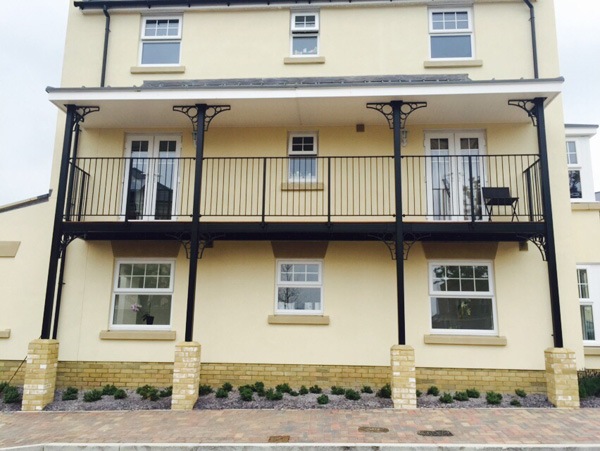
Balconies
Steel balconies, access walkways and replacement balcony railings for houses and blocks of flats.
See the pageFree quote
A photo, a rough height and a few words. Priced today.
Attach a phone photo of the spot, or a drawing, tell us roughly how high, and we ring back the same working day with a figure. Architects and builders can attach a PDF or email a tender package instead. Once you like the figure we survey free of charge, anywhere within reach of Westerham Hill.