Home / Gates, railings & more / Palisade fencing
Gates, railings & more
Palisade fencing for yards, schools and commercial boundaries
Palisade is the boundary you put up when you want a perimeter that is hard to climb, hard to cut and cheap to keep. We supply and install steel palisade fencing and matching metal gates across Kent, Surrey and South London, from a single-unit yard to a school perimeter, hot-dip galvanised as standard and powder coated where you want colour.
How palisade fencing is built
A palisade fence is a row of vertical steel pales bolted to two horizontal angle rails, and the rails bolt to steel posts concreted into the ground at about 2.75 metre centres. The pales do the work. D-section pales are the standard choice for most boundaries. W-section pales are heavier and stiffer, harder to spread apart, and are what you specify when security is the point. Pale thickness runs from 2 to 3 mm. Rails are 45 by 45 mm or 50 by 50 mm angle, and posts are I-section, sized up as the fence gets taller. Everything is fixed with shear nuts, whose hex heads snap off once tight, so the fence cannot be taken apart from the outside with a spanner. BS 1722-12 is the British Standard for steel palisade and sets the sizes you will see quoted.
Heights, pale tops and where each suits
Standard heights are 1.8, 2.0, 2.4 and 3.0 metres, with 1.2 and 1.5 metres where you want a boundary marked rather than defended. Pale tops come three ways. Triple-pointed is the classic industrial top and the hardest to climb. Rounded and notched is the usual choice for schools, play areas, car parks and anywhere the public gets close, because there is nothing to catch on. Splayed, where the end of the pale is split and flared, is the middle ground. A 2.4 metre fence in triple-pointed W-section is the normal spec for a compound or the back of an industrial unit. A 1.8 metre rounded and notched D-section fence suits a school field or an allotment. On sloping ground each pale bolts to the rails on its own, so the fence rakes with the gradient rather than stepping.
Palisade gates to match
The gate is the weak point of any fence, so it is built heavier than the run. We make single and double leaf palisade gates from the same pales and rails, hung on heavy adjustable hinges off I-section or box posts set in bigger footings than the fence posts. Pedestrian gates are normally 1 to 1.2 metres wide. Vehicle gates run from 3 metres for a van up to 6 or 7 metres as a pair for lorries. Each leaf gets a drop bolt into a ground socket and a padlock hasp or a locking bar, and a pedestrian gate can have a slam lock so it latches shut behind staff. If the gate may be motorised later, say so at the survey and we will size the posts for the motors and leave a duct for the cable.
Galvanised or powder coated
Every pale, rail and post is hot-dip galvanised. That is the dull grey finish you see on most industrial palisade, and it needs no painting or upkeep for years. If you want colour, the galvanised parts are powder coated on top, most often green RAL 6005 for schools and parks or black RAL 9005 near a building, and any RAL colour is possible. Coating adds cost and a little lead time, but it softens the look where a fence runs beside offices or houses. The parts are finished before they are bolted up, so any hole drilled or end cut on site is dressed with zinc-rich paint to keep the protection continuous. Tell us at the survey if the fence will be seen from a reception or a road, because that usually decides whether coating is worth paying for.
Ground, planning and the free site survey
Posts normally go into concreted holes 600 to 900 mm deep, deeper as the fence gets taller. Where the line runs over concrete or tarmac we either core drill through it or bolt down base-plated posts, and we tell you which at the survey. The survey is free. We walk the boundary line with you, check levels, look for buried services and drainage where the posts will go, agree gate positions and swing, and confirm what happens to any existing fence. On planning, a fence up to 2 metres is usually permitted development, dropping to 1 metre where it fronts a road used by vehicles, and listed buildings are the main exception, so check with your council if in doubt. With that done you get a fixed quotation that only changes if the design changes.
Price and lead time
Palisade is priced by the metre, and the metre rate moves with height, pale section and thickness, and whether it is coated as well as galvanised. Gates are priced separately and account for most of the difference between jobs. Ground matters too: soft ground with clear access is quick, core drilling a slab is slower, and taking out an old fence adds time. Because palisade is a standardised system, once the posts are in and cured the run goes up quickly, and a plain galvanised job moves faster than a coated one that has to go through the plant. We work from Westerham Hill, so Biggin Hill, Bromley, Croydon, Sevenoaks and Oxted are local jobs to us. Send a plan or a marked-up aerial view with the length and you will have a written estimate within the working day.
Straight answers on palisade fencing
Is palisade fencing suitable for a school?
Yes, with rounded and notched pale tops rather than pointed ones, usually at 1.8 or 2 metres and powder coated green or black. It is a common choice for school perimeters because it is hard to climb and easy to see through, which helps with supervision. Matching gates can have slam locks so they shut behind staff.
Is planning permission needed for palisade fencing?
Up to 2 metres high is normally permitted development, or 1 metre where the fence borders a road used by vehicles. Listed buildings are the main exception. Your council has the final say, so ask them if you are unsure, and keep any planning letter with the quotation.
Can palisade be fitted on a slope?
Yes. Each pale bolts to the rails on its own, so the rails can be set to follow the ground and the fence rakes with the gradient instead of stepping down in blocks. Where a bank is too steep for the pales to stay upright we step the run in short sections, and we tell you at the survey which it will be.
What is the difference between D-section and W-section pales?
Both are roll-formed steel pales. D-section is lighter and cheaper and fine for most boundaries. W-section is stiffer and harder to spread apart with a bar, so it is specified where security is the main point, usually in 3 mm thickness on a 2.4 or 3.0 metre fence.
Can you fit the fence on concrete or tarmac?
Yes. We either core drill through and concrete the posts in, or bolt base-plated posts to the slab. Which one depends on how thick and sound the slab is, and we check that at the survey rather than guessing from a photo.
How do I get a price for palisade fencing?
Send us a plan, a marked-up aerial view or photos with the run length and the height you want, and you will have a written estimate within the working day. If you want to go ahead we survey the site free of charge and then issue a fixed quotation, which only changes if the design changes. The phones are answered from 6am to 10pm, seven days a week.
Recent work
Related metalwork from the same workshop
Also in Gates, railings & more
Related work
Metal gates
Driveway, side, pedestrian and estate gates in galvanised steel, made to your opening, automation-ready.
See the page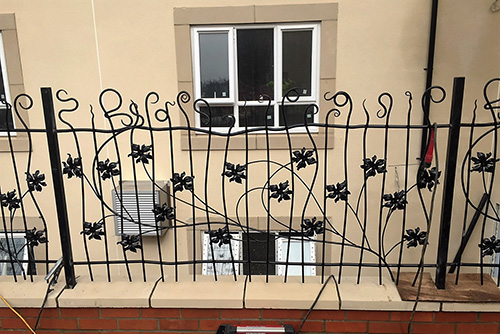
Metal railings
Garden, wall-top, step and ramp railings in period or plain styles, galvanised and powder coated.
See the page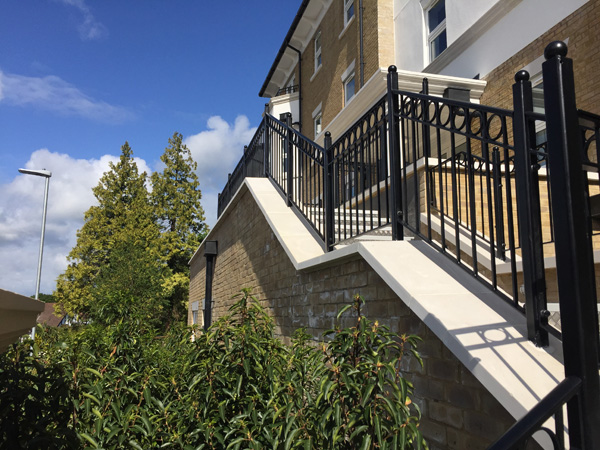
Mesh fencing
Rigid galvanised mesh panels and gates for schools, sports grounds, yards and boundaries.
See the pageFree quote
A photo, a rough height and a few words. Priced today.
Attach a phone photo of the spot, or a drawing, tell us roughly how high, and we ring back the same working day with a figure. Architects and builders can attach a PDF or email a tender package instead. Once you like the figure we survey free of charge, anywhere within reach of Westerham Hill.