Home / Gates, railings & more / Mesh fencing
Gates, railings & more
Mesh fencing
Welded mesh fencing is the plain answer to most boundary and security jobs: you can see through it, it is hard to climb and it lasts. We supply and fit rigid panel systems for schools, sports grounds, yards and homes across Kent, Surrey and South London, with one team surveying, making and fitting from our workshop at Westerham Hill on the North Downs.
Which mesh fencing system you need
There are three mesh fencing systems worth knowing, all rigid panels rather than rolled wire. V-mesh is a single-wire panel pressed with V-shaped beams for stiffness. It is the cheapest and suits residential boundaries, car parks and lower-risk sites at 1.2m to 2.4m high. Twin-wire panels, sold as 868 or 656 after their wire sizes in millimetres, run a pair of horizontal wires either side of each vertical, so they are stiffer and far harder to cut; they are the usual choice for schools and commercial yards. 358 anti-climb mesh has a 76mm by 12.7mm aperture, which leaves no toe-hold and no room for bolt croppers, so it is the one for compounds and plant that need medium to high security. We specify the one your site needs rather than the dearest.
Posts, fixings and gates
Panels fix to 60mm by 60mm square hollow section posts up to 2m high, moving to 80mm by 80mm for taller runs, corners and gate posts. Posts are either concreted into holes around 300mm across and 600mm deep, or base-plated and bolted down with resin anchors on a slab or the top of a wall. Panels clamp to the posts with anti-tamper fixings on shear nuts, so the hex snaps off once tight and cannot be undone from outside. On a slope the panels step or rake, and we work that out on site so the gap at the bottom stays under 100mm. Matching gates, single or double leaf, are made in our workshop on RHS frames with the same mesh, heavy-duty adjustable hinges and a lockable slam plate.
Galvanised steel and powder coating
All of it is galvanised steel: panels, posts, clamps and gate frames. Panels are galvanised at manufacture; posts and gates are hot-dip galvanised after fabrication, so there is no bare steel to rust. Our standard outside finish is a polyester powder coat over the galvanising, because bare galv weathers to a dull grey and a coated fence sits better against a building. Green (RAL 6005) is the norm for schools and sports grounds, black (RAL 9005) and anthracite (RAL 7016) for houses and offices, and any other RAL colour can be done at a small premium. If the run is out of sight and the budget is tight, galvanised only is a sound choice. Coating adds a little to the price and the lead time, and you will know both before you order.
School fencing and sports ground fencing
Schools and sports grounds are where most mesh fencing ends up, because you need to see the playground and the pitch as well as keep people out. For school fencing the usual spec is 2m or 2.4m twin-wire in green, with a flat top rather than spikes, self-closing gates and no horizontal rails for a child to climb. For sports ground fencing the panels go higher: 3m to 5m ball-stop fencing behind goals and around multi-use games areas, with heavier rebound panels at the bottom so the ball comes back into play. Tall runs like that need planning permission and a look at wind loading, and where the council or your engineer wants drawings and calculations we supply them. Ask for panels made to BS 1722-14, the British Standard for open mesh steel panel fences.
Where mesh fencing works and where it does not
Mesh suits construction sites, industrial and warehouse units, retail and office car parks, airport and utility compounds, and the side and rear boundaries of houses where a close-board fence would take the light. Mesh fencing in London mostly means yards and compounds; out in Kent and Surrey it is more often schools, sports grounds and house boundaries. It goes up fast, costs less per metre than railings, and you can see who is on the other side. It is not right everywhere. On a front garden in a conservation area railings look right and mesh does not; where you want privacy, mesh gives none unless you add slats or a screen; and on North Downs chalk and flint, post holes take longer and the estimate allows for it. If railings would serve you better, we make those too.
Survey, price and lead time
Send a photo of the run and a rough length and you will have a written estimate within the working day. Then we come out and measure for free, anywhere within forty miles of Warlingham and across Kent, Surrey and South London, from our workshop at 4 Fort Cottages, Westerham Hill, TN16 2ED. The survey checks the ground, the levels, where services run, what the gates need to do and whether the boundary is where you think it is. Price is driven by height, mesh type, the number of gates and corners, and whether posts are dug in or bolted down. The quote is fixed unless the design changes. Green or galvanised V-mesh and twin-wire go in quickly; other colours and 358 take longer because they are coated to order. The phone is answered from 6am to 10pm, seven days a week.
Straight answers on mesh fencing
Is planning permission needed for mesh fencing?
Not usually. A fence up to 2m high is permitted development, or up to 1m where it fronts a highway. Anything taller, and any fence within the grounds of a listed building, needs permission from the council, and some conservation areas carry extra restrictions. Ball-stop fencing at 3m and above always needs it. We check this when we measure and tell you before you commit.
How high can mesh fencing go?
Standard V-mesh and twin-wire panels run from 1.2m to 3m. Ball-stop fencing for sports grounds goes to 4m or 5m on heavier posts. Above about 2.4m the post section goes up, the footings go deeper and wind loading starts to matter, which is what moves the price.
Is mesh fencing secure enough for a yard or compound?
Twin-wire 868 with anti-tamper clamps is hard to cut or lift and is the usual choice for commercial yards. If you need more, 358 anti-climb mesh has no foothold and resists bolt croppers, and a topping of rotating spikes or barbed wire can be added where the site allows it. Barbed wire beside a public road brings its own rules, so ask us first.
Can you fit gates to match?
Yes. Single and double leaf swing gates in the same mesh and colour, on RHS frames with adjustable hinges, from a 1m pedestrian gate to a 6m double for vehicles, and cantilever sliding gates where there is no room for leaves to swing. Locks, closers, drop bolts, keypads and access control are all options.
Will mesh fencing rust?
Not if it is galvanised, and all of ours is. The zinc protects the steel even where the coating gets chipped, and where we cut a panel on site the cut ends get zinc-rich paint before we leave. Keep strimmers off the bottom wire and it needs no painting or maintenance beyond a hose down.
Can you fit mesh fencing on a slope or on top of a wall?
Yes. On a slope, twin-wire and 358 panels step down post by post and V-mesh can rake to follow the ground; either way the gap at the bottom stays under 100mm so nothing gets under. On a wall the posts sit on base plates resin-anchored into a sound wall or concrete coping, which also suits slabs and car park decks where you cannot dig.
Recent work
Related metalwork from the same workshop
Also in Gates, railings & more
Related work
Metal gates
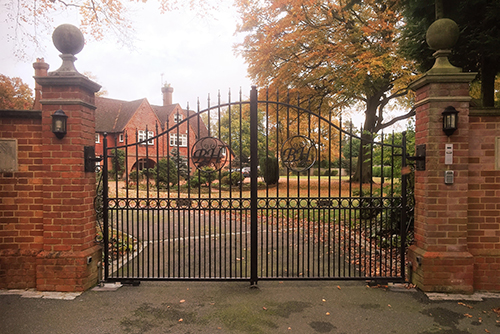
Driveway, side, pedestrian and estate gates in galvanised steel, made to your opening, automation-ready.
See the page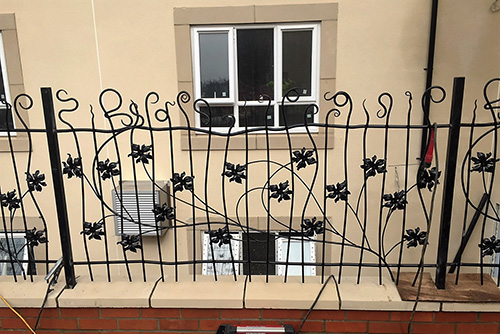
Metal railings
Garden, wall-top, step and ramp railings in period or plain styles, galvanised and powder coated.
See the page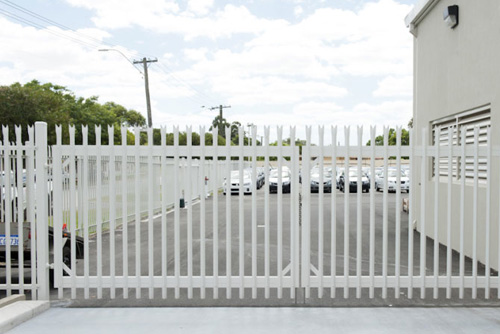
Palisade fencing
Metal palisade fencing and matching gates for yards, schools and commercial boundaries, galvanised or powder coated.
See the pageFree quote
A photo, a rough height and a few words. Priced today.
Attach a phone photo of the spot, or a drawing, tell us roughly how high, and we ring back the same working day with a figure. Architects and builders can attach a PDF or email a tender package instead. Once you like the figure we survey free of charge, anywhere within reach of Westerham Hill.