Home / Gates, railings & more / Key clamp
Gates, railings & more
Key clamp handrails and guardrails
Key clamp is galvanised steel tube joined with cast iron fittings locked on by a grub screw. No welding, no hot work on site, and it goes up quickly. We fit it as handrail on wheelchair access ramps and steps, guard railing round roof edges and plant, and barriers in yards and car parks across Kent, Surrey and South London. Send photos for an estimate within the working day.
What key clamp is and where it makes sense
Key clamp, also sold as tube clamp, is a system of galvanised steel tube and malleable cast iron fittings: base flanges, elbows, tees, crosses and adjustable knuckles for rakes and odd angles. Each fitting slides over the tube and a grub screw is pulled up tight with a hex key. Nothing is welded, so there is no grinding, no paint touch-up and no hot work on site, and a run can be altered or extended later with the same key. It suits handrails, guard railing, safety barriers, racking frames and pedestrian guarding in commercial, industrial and domestic settings. It is not the right choice where you want a slim or decorative rail. For that you want a welded steel or stainless balustrade, which we also make.
Key clamp handrails for wheelchair access ramps and steps
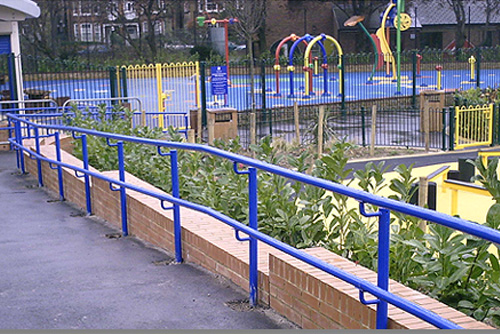
Most of the key clamp we fit is handrail: along wheelchair access ramps, up a flight of external steps, or beside a sloping path. For a ramp to a shop, surgery or office, Approved Document M asks for a handrail on both sides, 900 to 1000 mm above the ramp surface, carried 300 mm past the top and bottom and closed back to the post so a sleeve cannot catch. It allows a round rail of 32 to 50 mm, and BS 8300 narrows that to 40 to 45 mm, so size 7 tube at 42.4 mm is the usual pick. On steps, Approved Document K wants the same height and a rail each side once the flight is 1000 mm or wider. Posts stand on base flanges or side-fix to a wall or the edge of the steps.
Roof edge protection and plant guard railing
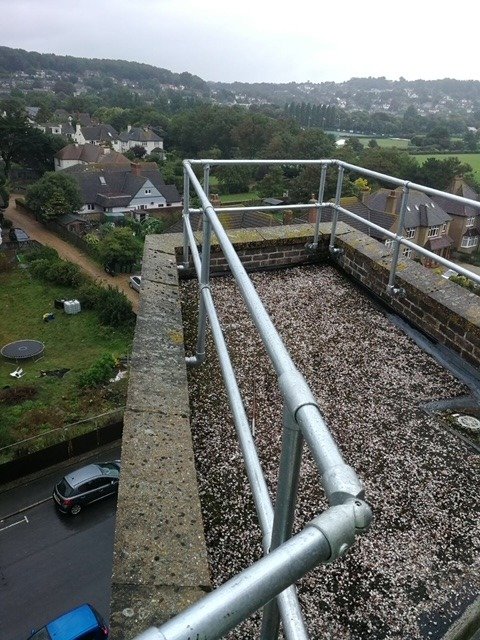
Anyone who goes onto a flat roof to service air conditioning, clear gutters or check a rooflight is working at height, and the Work at Height Regulations expect whoever controls that work to guard the edge. A key clamp guard railing does that with no welding on the roof. The regulations set the top rail at a minimum of 950 mm, but we normally build to 1100 mm to match BS 6180 and Approved Document K for a roof edge, with a mid rail so no gap is over 470 mm and a toe board where tools could be kicked off. Posts fix to the parapet or upstand, or on a membrane roof a freestanding counterweighted frame keeps every fixing off the covering. We also guard rooflights, plant platforms and the drop beside a loading bay.
Barriers in yards, car parks and depots
Key clamp makes a quick barrier where people and vehicles mix: along a walkway through a yard, round the edge of a car park deck, or as a rail to stop trolleys rolling into a loading bay. BS 6180 sets the sideways load a barrier has to take, and it rises where a crowd could lean on it, so we set the post centres to suit, usually 1.5 to 2 metres and closer where the load is higher. Posts go on base flanges through-bolted to concrete, or are concreted into the ground where there is no slab. Mesh panels clamp into the frame where children will be about, so nothing wider than 100 mm can pass. For visibility we powder coat in safety yellow or black over the galvanising, and a gate can be built into any run.
Tube sizes, finishes and fixings
Key clamp tube comes in several sizes. The two we use most are size 7 at 42.4 mm, the handrail size, and size 8 at 48.3 mm, which we prefer for guard railing and barriers because it stiffens the run and takes a longer post spacing. The tube is galvanised and the fittings are hot-dip galvanised, so the bare system lasts outside without paint and weathers to a dull grey. Powder coating over the galvanising gives you a colour and suits a rail on show. Fixings depend on what the post is landing on: through-bolts or resin anchors into concrete, resin studs into brick, and a spreader plate or a fabricated bracket for a parapet or a steel beam. We check the base at the survey, because a flange bolted to weak screed is where these jobs go wrong.
Price and lead time
Key clamp is priced by the metre of rail plus the number of posts, corners and gates, so a straight run along a wall costs least and a stepped rail down a ramp with returns costs more. Ground fixing matters too: bolting to sound concrete is quick, while coring out and concreting posts takes longer. Galvanised tube and fittings are stock items, so a plain handrail is not held up waiting for material. A powder coated job goes to the plant first, which adds time, and we tell you how much when we quote. Send photos of the ramp, steps or roof with a rough length and you will have a written estimate within the working day. The site survey is free, the quotation holds unless you change the design, and the phones are answered from 6am to 10pm, seven days a week.
Straight answers on key clamp
Is key clamp strong enough for roof top safety guard railing?
Yes, when it is built to the standard. With size 8 tube, posts at the right centres and sound base fixings it meets the loads in BS 6180 and the 950 mm minimum in the Work at Height Regulations. We size it for the roof in front of us, not from a catalogue picture, and can supply drawings and structural calculations where building control or a principal designer asks for them.
Does key clamp need welding?
No. Every joint is a cast fitting locked to the tube with a grub screw, so there is no hot work, no fumes and no burnt paint. That is why it suits occupied buildings, roofs with a membrane, and sites where a hot work permit would hold the job up.
Can you make a ramp handrail comply with Part M?
Yes. We use 42.4 mm tube at 900 to 1000 mm high, a rail on both sides, 300 mm extensions at each end and closed ends. If building control is inspecting the ramp we supply a drawing showing the heights and extensions.
Will galvanised key clamp rust?
Galvanising is a zinc coating that corrodes slowly in place of the steel, so the tube and fittings weather to a dull grey rather than rusting. A knock that breaks through can be touched up with zinc paint. If you want a colour or a smarter finish, we have it powder coated over the galvanising before it comes to site.
Where do you fit key clamp?
Across Kent, Surrey and South London from our workshop at 4 Fort Cottages, Westerham Hill, Westerham, Kent TN16 2ED: Biggin Hill, Bromley, Keston, Orpington, Croydon, Caterham, Oxted, Sevenoaks and the villages between.
Can you add to a key clamp rail later?
Yes. Because nothing is welded, a run can be extended, a gate added or a post moved with the same fittings and a hex key. Keep a note of the tube size and we can match it.
Recent work
Key clamp we have made and fitted
Also in Gates, railings & more
Related work
Metal gates
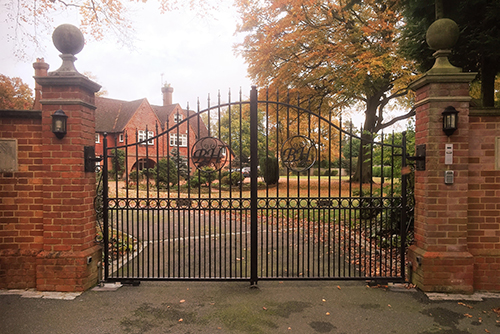
Driveway, side, pedestrian and estate gates in galvanised steel, made to your opening, automation-ready.
See the page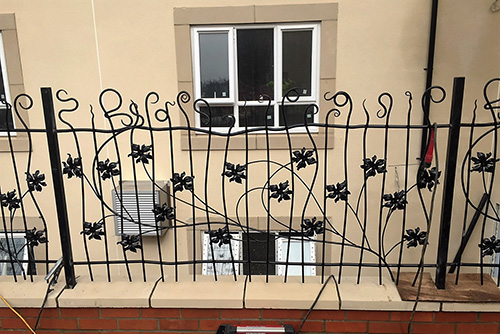
Metal railings
Garden, wall-top, step and ramp railings in period or plain styles, galvanised and powder coated.
See the page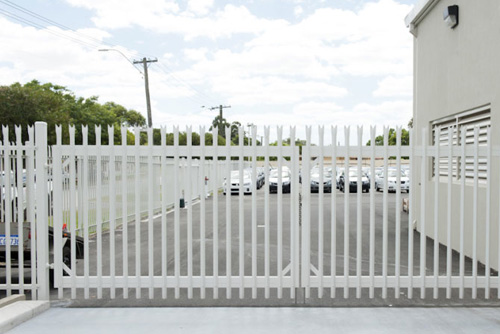
Palisade fencing
Metal palisade fencing and matching gates for yards, schools and commercial boundaries, galvanised or powder coated.
See the pageFree quote
A photo, a rough height and a few words. Priced today.
Attach a phone photo of the spot, or a drawing, tell us roughly how high, and we ring back the same working day with a figure. Architects and builders can attach a PDF or email a tender package instead. Once you like the figure we survey free of charge, anywhere within reach of Westerham Hill.